



Interest rates
How a spot market prices borrowing: one straight line to the optimal utilization point, then six progressively steeper segments up to 100%.
The borrow rate of a spot market is a function of one input, its utilization, and it is the same function that sets what lenders receive. This page is the curve: where it bends, what each segment is worth, and which parameters a market sets for itself.
Why not one straight line
A single slope from zero to full utilization cannot both price ordinary credit and price the emergency. Calibrate it to charge 50% annualized at 100% utilization, where no lender can withdraw and the rate has to force repayment, and it charges 40% annualized at a healthy 80% utilization, so borrowers leave. Calibrate it to a sane 10% annualized at 80% instead and it arrives at only 12.5% annualized at 100%, where the market is full, no depositor can withdraw, and nothing in the price is telling anyone to repay.
A kinked curve solves it by using different slopes over different ranges. Each kink is a point at which the protocol has decided that utilization has become more dangerous than it was.
The shape
Every spot market defines four numbers, all set by the admin:
| Symbol | Parameter | What it is |
|---|---|---|
U* | Optimal utilization | The target utilization, where the first kink sits |
R_opt | Optimal borrow rate | The borrow rate at U*, annualized |
R_max | Maximum borrow rate | The borrow rate at 100% utilization, annualized |
R_min | Minimum borrow rate | A floor applied to the result, annualized. Every market is created with this at zero |
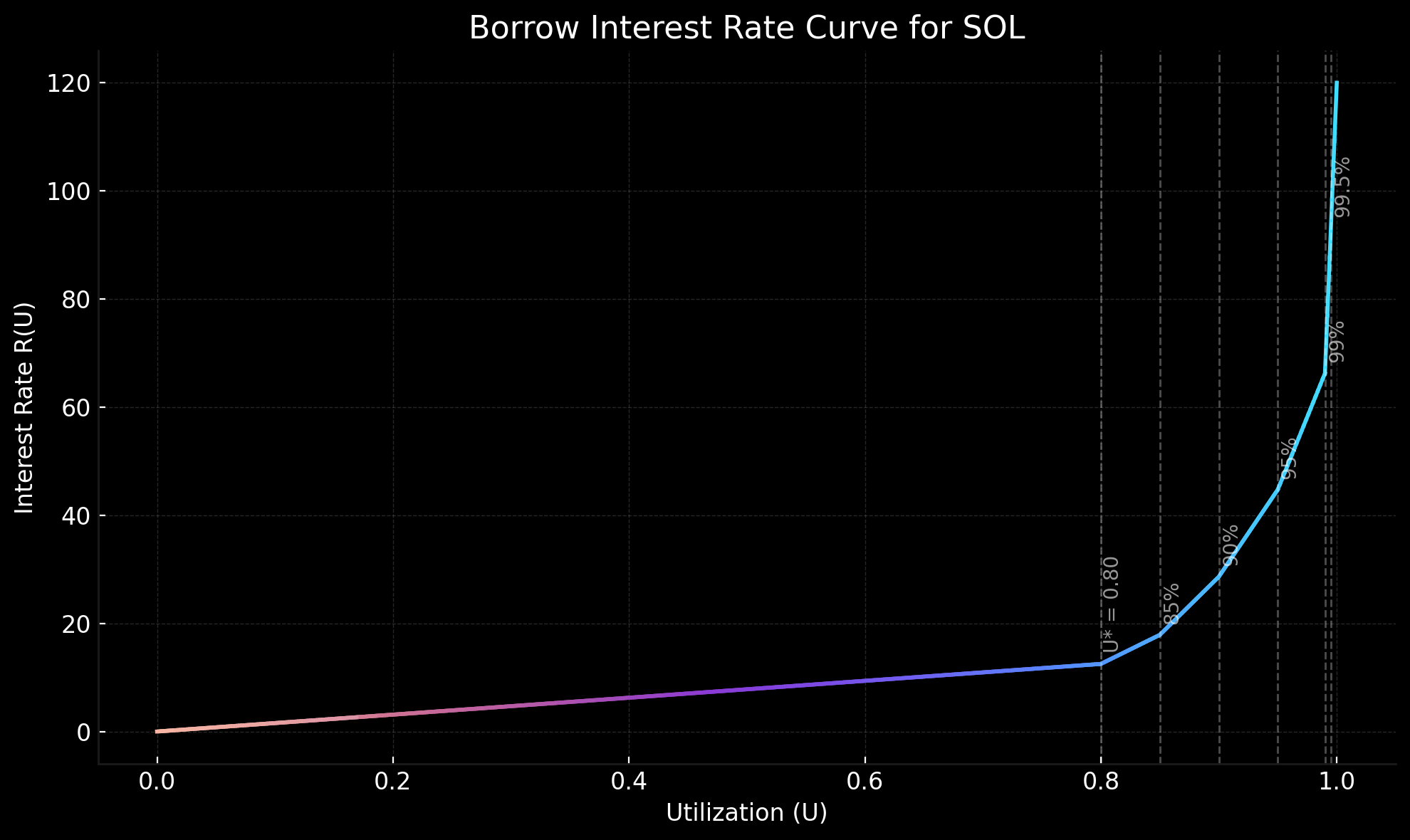
Below U* the curve is a single straight line from the origin, so the rate is R_opt scaled by how far along that leg utilization sits. Above U* the remaining rate budget, R_max less R_opt, is divided across six fixed segments:
| Segment | Share of the budget |
|---|---|
U* to 85% | 5% |
| 85% to 90% | 10% |
| 90% to 95% | 15% |
| 95% to 99% | 20% |
| 99% to 99.5% | 25% |
| 99.5% to 100% | 25% |
Segments accumulate: a utilization inside a segment collects every earlier segment in full plus its own share pro rata, and the result is floored at R_min.
Half of the whole budget is spent in the last one and a half points of utilization. The curve stays gentle where the market is healthy, so the rate is not volatile around the target, and turns nearly vertical exactly where a lender's ability to withdraw is disappearing. The segment boundaries and their weights are protocol-wide constants that no market can change, so U* always sits below 85%.
Worked example
The parameters here are illustrative. Read the live ones off the market page in the app.
Take U* at 80%, R_opt at 10% annualized, and R_max at 50% annualized, so the budget above the kink is 40 points of rate.
| Utilization | Borrow rate, annualized | Cost of the next point of utilization |
|---|---|---|
| 0% | 0.00% | 0.125 points |
| 80% | 10.00% | 0.4 points |
| 85% | 12.00% | 0.8 points |
| 90% | 16.00% | 1.2 points |
| 95% | 22.00% | 2.0 points |
| 99% | 30.00% | 20 points |
| 99.5% | 40.00% | 20 points |
| 100% | 50.00% |
Between 80% and 85% a borrower pays 0.4 points more for each point of utilization they add. Between 99% and 100% they pay 20 points more, fifty times as much, and the last half point of the pool costs as much rate as the first ninety-nine.
Boundaries
- At zero utilization no interest accrues at all, on either side, so a minimum rate does not charge an idle market.
- Borrows with no deposits price at 100% utilization, which puts the market at its maximum borrow rate.
- The floor applies after the curve, so a market with a minimum rate charges it across the whole lower leg until the linear ramp overtakes it.
Who sets these
Changing the curve requires the warm or cold admin key, and the four numbers are set together. An update is rejected unless utilization is at or below 100% and the three rates are ordered R_min at or below R_opt at or below R_max.
The same curve prices both sides of the market. Lenders receive this borrow rate scaled by utilization and net of the two carve-outs, which is why the lending rate is always below the borrow rate and why it collapses toward zero as utilization does. See Borrow and lend for that arithmetic and for a worked example that starts from a deposit.
Borrow and lend
Every deposit on Velocity is lendable, every withdrawal past zero is a borrow, and one utilization number sets the price of both.
Withdrawal and borrow limits
A market-wide throttle on how far a spot market's deposits can drain and its borrows can grow in a rolling window, checked on top of the account's own margin.